
Criminal Cases in the Oscoda County Courts
The 81st District Court is the first court for most Oscoda County criminal matters. It hears misdemeanors within its jurisdiction and opens the early record in a felony: the complaint, arraignment, bond decision, probable-cause conference, and preliminary examination or waiver. If probable cause supports a felony charge, the District Court binds the case over. The 23rd Circuit Court then holds the felony information, circuit arraignment, motions, plea or trial, judgment, and sentence. A search limited to one jurisdiction can therefore miss half of a felony's path.
Both courts use the Courthouse Annex and Central Filing Office at 105 S. Court Street, P.O. Box 399, Mio, MI 48647. District Court publishes 989-826-1105 and 989-826-1106; Circuit Central Filing publishes 989-826-1111. Both list weekday counter hours of 8:30 a.m. to 4:30 p.m. Oscoda County has no incorporated city and no municipal criminal court, so there is no city clerk holding a separate local criminal docket.
The official 81st District Court page shows the local court contact and courthouse setting.
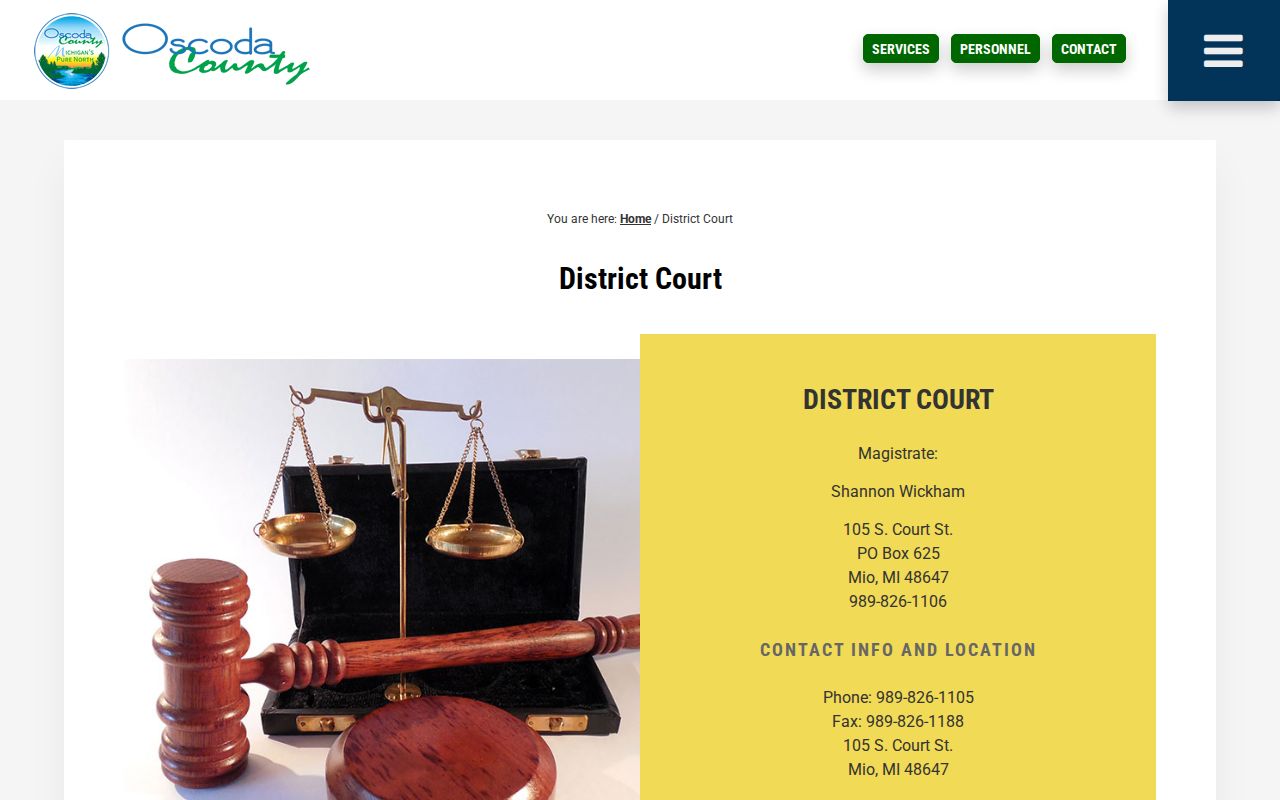
That office is the practical first stop when an Oscoda County felony has not yet reached Circuit Court.
Two Oscoda County Felony Records
One felony can produce two Oscoda County case records without being two separate prosecutions. The District Court segment records the first charging and probable-cause stages. The Circuit Court segment begins after bindover and records the prosecution through its final result. Search both by name, then follow the case numbers and dates in the registers of actions. A bindover entry in the district docket and an information filed in Circuit Court are the key handoff points.
The 23rd Circuit Court page identifies the Mio Central Filing Office within a circuit that also covers Alcona, Arenac, and Iosco Counties.
The four-county structure does not move an Oscoda filing out of Mio; local records stay with Oscoda Central Filing.
How to Search Case Records
MiCOURT Case Search is the main free index for participating Michigan trial courts. An exact case number is the strongest key. A party-name search is useful when the number is unknown, but spelling, court participation, protected status, and a court's date filter can change the result. MiCOURT itself treats its data as informational; the court's file remains the official record.
- Open MiCOURT, accept its terms, and select the participating Oscoda County court that fits the stage of the case.
- Search by exact case number when known, or use the participant's last name with a first name to narrow matches.
- Repeat the search in District and Circuit Court when a felony may have crossed the bindover point.
- Open the case detail and read the register of actions from filing through the latest event, checking each charge separately.
- Ask Central Filing through Court NextRequest, by phone, or at the counter for the named document or a certified copy.
| Field Label | Type | Required | Notes |
|---|---|---|---|
| Court | Selector | Yes | Choose a participating trial court; displayed case types vary. |
| Search By | Tabs/control | Yes | Select case number or party/participant name. |
| Case Number | Text | Alternative | Use the exact or supported partial format for the court. |
| First Name | Text | No | Use with a last name to narrow party matches. |
| Last Name | Text | Name basis | This is the core field for a participant-name search. |
| Search/Submit | Button | Yes | Runs the selected query. |
| Reset/Clear | Button | No | Clears criteria when displayed. |
Name results can include more than one person or case. Confirm the court, case number, dates, and party role before requesting an underlying Oscoda County document.
Oscoda County MiCOURT Warnings
MiCOURT can show the court, case number, judge, filing date, status, parties, attorneys, charges, statute, hearings, bond, register entries, dispositions, and sentence entries when the participating court supplies them for public view. It is still an index, not a full packet of pleadings. Some courts apply a seven-year criminal-sentence filter, and MiCOURT excludes protected categories such as juvenile and child-protection cases, adoption matters, certain personal protection proceedings, mental-illness matters, and treatment cases.
The official MiCOURT interface shows the search controls and the terms a user accepts before searching.
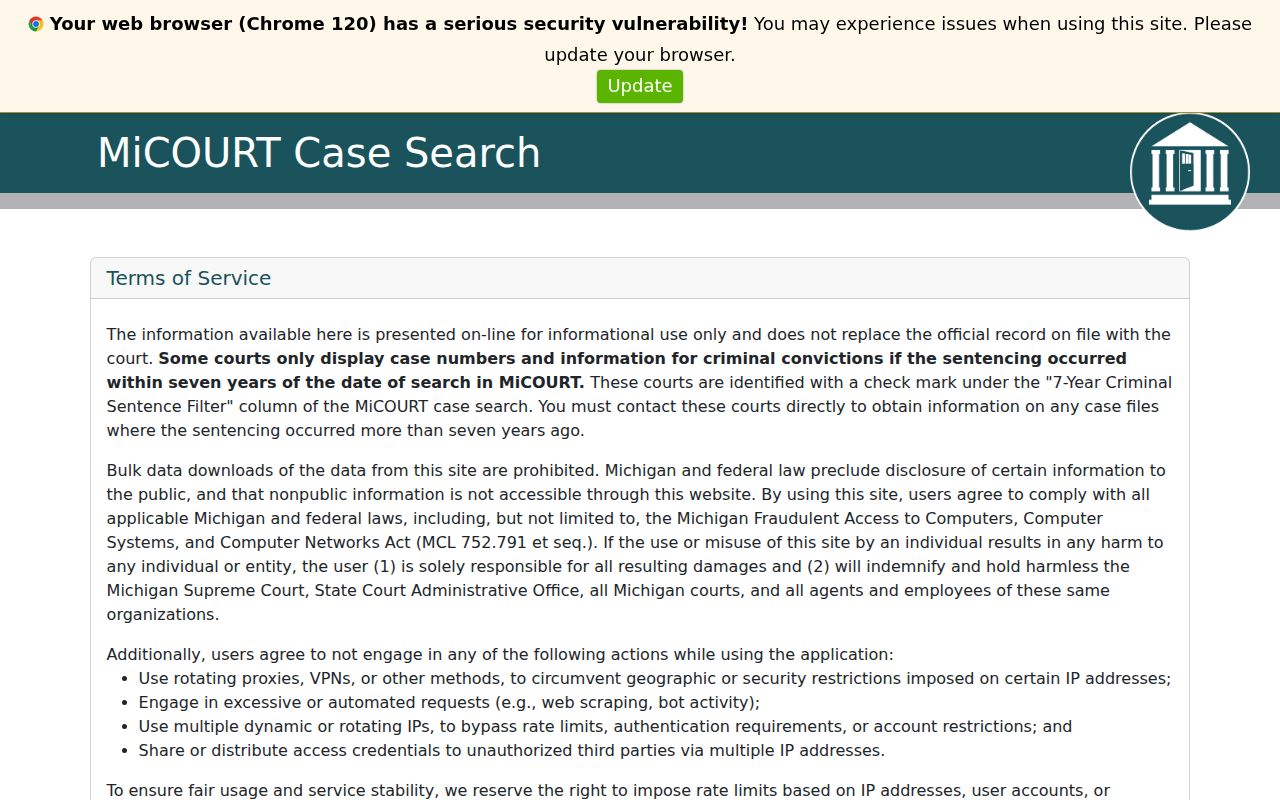
A blank search is not proof that no Oscoda County case exists; use the clerk channel when scope or display rules may explain the gap.
What the Case File Shows
A docket answers when events happened, while the underlying Oscoda County documents explain what was alleged, ordered, or decided. Ask by title when the result matters. The complaint and warrant state the initial allegations; the information states the felony charges carried into Circuit Court; and the judgment of sentence records the outcome after conviction. A register of actions is useful for tracing the whole file, but a short event label should not be read as a substitute for the signed order.
| Case Number & Court | Identifies the jurisdiction and lets the clerk locate the District or Circuit Court file. |
|---|---|
| Charging Document | The complaint starts the case; an information states felony charges after bindover or waiver. |
| Docket Entries | The register of actions lists filings, hearings, orders, pleas, and later events in date order. |
| Hearing Dates | Shows past events and scheduled proceedings, subject to later court changes. |
| Disposition & Judgment | Records the result for each charge, including conviction, acquittal, dismissal, or other outcome. |
| Sentence & Conditions | May show jail or prison, probation, restitution, and other court-ordered terms. |
For a final outcome, compare the charge-level disposition with the signed judgment and later postjudgment orders. A case-level status alone is not enough.
Oscoda Court Documents by Request
When the public docket lacks the needed PDF, use Oscoda Court NextRequest. The portal accepts court-record requests and lets users search prior releases. It also hosts court material such as local administrative orders, jury information, brochures, and speeding-ticket costs. A good request names the court, case number, party, and exact document, such as the complaint, bond order, information, plea form, order of dismissal, judgment of sentence, probation order, or register of actions.
The official court portal presents the online route for an older, filtered, missing, or document-level Oscoda County criminal case request.
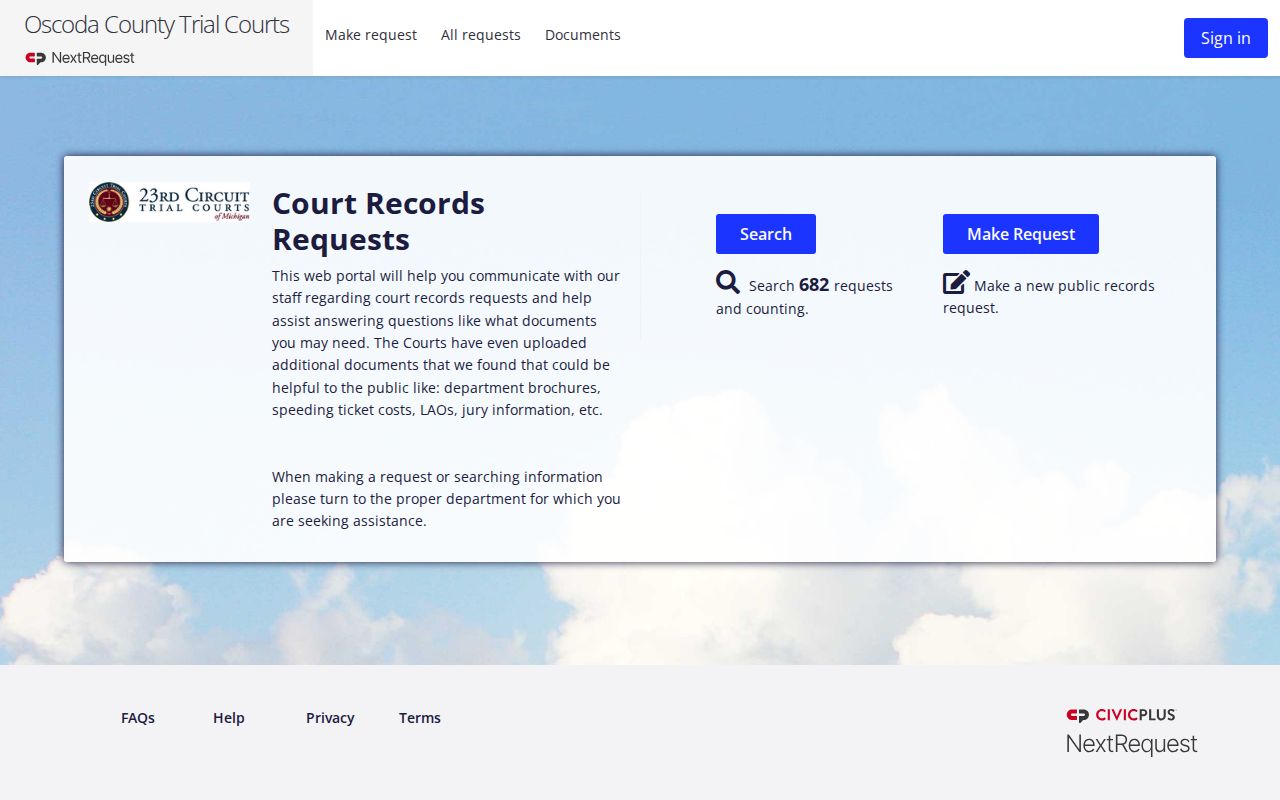
Submission is one access channel, not a promise that every filed item is public or already scanned.
For direct help, call Circuit Central Filing at 989-826-1111 or District Court at 989-826-1105 or 989-826-1106. A requester may also visit the 105 S. Court Street counter during its published weekday hours or mail a focused request to P.O. Box 399, Mio, MI 48647. Ask expressly for certification when an ordinary copy will not serve. The research does not verify a current per-page or certification price, so confirm cost before ordering.
Stages of a Criminal Case
An Oscoda County case file grows one court event at a time. Charges are filed before arraignment, where rights, the charge, a plea when allowed, and bond may be addressed. A felony stays in District Court for the probable-cause conference and preliminary examination unless that hearing is waived. Bindover sends the matter to Circuit Court, where an information, circuit arraignment, pretrial motions, plea negotiations, or trial lead to a disposition. A conviction is followed by sentencing and may produce probation or later postjudgment entries.
Case flow: Charges Filed › Arraignment › Pretrial › Plea or Trial › Disposition › Sentencing
The process line is a reading order, not a fixed timetable. Adjournments, waivers, dismissals, amended charges, and postjudgment motions may change the number and sequence of docket entries.
Oscoda Criminal Case Status Terms
“Disposed” or “closed” is a case-status label, not a synonym for guilty. Read the outcome beside each charge. A dismissal ends a charge without a conviction. An acquittal is a not-guilty result after trial. A conviction follows a guilty plea or verdict. “Nolle prosequi,” often shortened in a docket, reflects the prosecutor's formal decision not to continue a charge. If a plea agreement changes counts, compare the original complaint with the final disposition rather than assuming every first-filed count produced judgment.
- Bindover
- The transfer of a felony from District Court to Circuit Court after probable cause or a waiver.
- Register of actions
- The dated list of filings, hearings, rulings, and other events in the court case.
- Bond
- Security and conditions used to support appearance and public safety while the case is pending.
- Disposition
- The result of a charge or case, which must be read charge by charge.
- Sentence
- The consequence ordered after conviction, distinct from the charge and plea.
These terms describe different steps. Reading them in date order helps prevent a bond entry, plea, or closed status from being mistaken for the final judgment.
Access & Restrictions
Michigan Court Rule 8.119 governs court records and public access, but access is not unlimited. Juvenile and child-protection matters, adoption records, mental-illness proceedings, some personal protection information, treatment matters, and protected personal identifiers do not appear like ordinary public criminal files. A set-aside can also remove a qualifying conviction from ordinary public view while a limited nonpublic record remains available for authorized purposes. The absence of an online result may reflect a restriction, filter, or court participation issue rather than the absence of any record.
The Michigan Freedom of Information Act supports access to records held by public bodies, but it does not override court access rules or require an office to create a new explanation. For a court filing, start with Central Filing and Court NextRequest instead of sending the same request to the sheriff or general county portal. A clerk can explain how to request an available file, though court staff cannot supply legal advice.
Oscoda Prosecutor and Court Records
The Oscoda County Prosecuting Attorney authorizes and prosecutes charges, but the clerk is the custodian for filed criminal case records. That distinction keeps requests on the right track. Questions about a public complaint, hearing entry, judgment, or certified copy belong with the court. A prosecutor file may contain work product, victim information, or investigative material that is not the same as the public court file and may be restricted.
The official prosecutor page identifies the local office and its role on the county justice campus.
Use that role distinction to request the filed case from Central Filing while directing an agency-created incident report to the agency that made it.